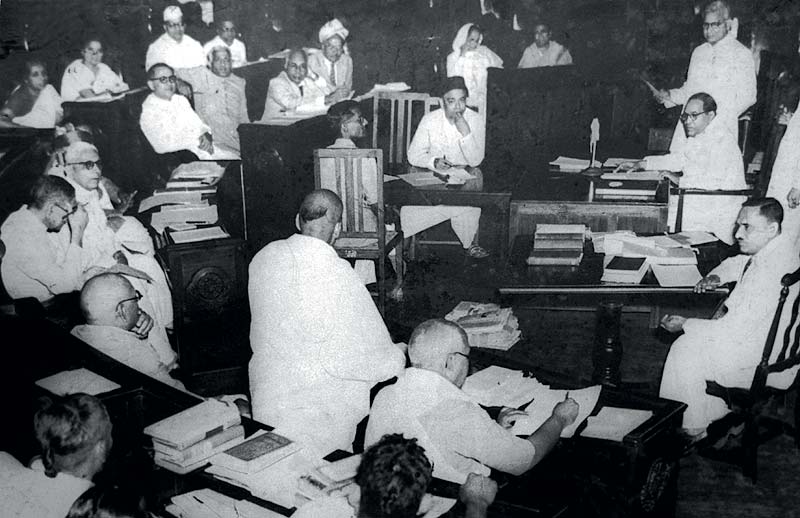
More heat is spent on reservation than on almost any other part of the Constitution, and most of it treats reservation as a single thing that is either sacred or outrageous. It is neither, and it is not single. Here is the machinery.
It is several policies, not one
[Documented] “Reservation” bundles at least three distinct mechanisms, on different articles:
- Political reservation — reserved seats in legislatures for Scheduled Castes and Scheduled Tribes (Articles 330, 332). This is the one with a time limit: Article 334 sets a ten-year sunset that Parliament renews each decade.
- Educational reservation — reserved places in schools, colleges and universities (Article 15(4), 15(5)). No time limit.
- Employment reservation — reserved posts in public services, including in promotions (Articles 16(4), 16(4A)). No time limit.
This immediately dissolves the “reservations were only meant to last 10 years” claim: the sunset applies only to reserved legislative seats, never to education or jobs. (See Record vs Rumor.)
Who it covers — and by what unit
[Documented] Three broad categories, and they are not the four varnas — they are lists of specific communities:
- Scheduled Castes (SC) — ex-untouchable communities (outside varna).
- Scheduled Tribes (ST) — Adivasi communities, largely outside caste-Hindu society.
- Other Backward Classes (OBC) — socially and educationally backward castes, many of them Shudra-varna service and artisan jatis.
Note what this means: reservation sorts by jati-based category, not varna. A Shudra-varna community can be “forward” (no reservation) or OBC depending on the specific caste — which is why the wizard shows old-code varna and new-code category as two separate axes.
Where the OBC number came from
The SC and ST lists inherit their boundaries from the colonial schedules; the OBC category had to be built from scratch after 1950 — and its history is messier and more honest than either side usually admits. The Constitution (Article 340) provided for a commission to identify “socially and educationally backward classes.” It took two, thirty years apart, to produce the 27%.
The first, under Kaka Kalelkar (1953–55), listed 2,399 backward castes — and then did something almost unheard of: its own chairman, in his covering letter, argued against his own report, having come to fear that caste-based remedy would entrench the very thing it fought. The government shelved it. This site does not hide that: the strongest doubt about caste-based reservation was raised not by an opponent but by the man appointed to design it. [Debated]
The second, the Mandal Commission (report 1980), is where the familiar numbers come from: OBCs estimated at about 52% of the population, 3,743 castes identified as backward, and a recommended 27% reservation — set below the population share precisely to stay within the Court’s emerging 50% ceiling. Shelved again for a decade, it was implemented in 1990, drew fierce protest, and was then tested in Indra Sawhney below. [Documented]
So when someone asks “where did 27% come from?”, the honest answer is neither “picked out of the air” nor “settled science”: it came from a contested, thirty-year commission process, argued over at every step — including by its own first author. That the number is debatable is not a scandal; it is the record.
The limits the Court built in
Reservation is not unbounded, and the boundary is judicial. In Indra Sawhney v. Union of India (1992) — the “Mandal” case — the Supreme Court:
- upheld 27% reservation for OBCs in central government jobs;
- capped total reservation at 50% in normal circumstances;
- required exclusion of the “creamy layer” — the better-off among OBCs — so the benefit reaches those who actually need it.
[Documented] So the popular image of limitless quota is wrong on the law: there is a ceiling and a means test built into the doctrine.
Where it reaches — and where it doesn’t
The single most common grievance — “a lower-scoring candidate took the job a higher scorer deserved” — usually rests on two misunderstandings: where reservation applies, and how it is counted. Take them in turn.
Employment reservation is a public-sector rule (Article 16(4)). The private sector — where the overwhelming majority of Indians actually work — carries no caste reservation at all. India has roughly 60 crore workers; the organised sector is about 9.55 crore of them, and the public sector where reservation applies is only around 1.7 crore — a few percent of all jobs. Close to 89% of all employment is informal, with neither reservation nor much job security.
Where employment reservation reaches · India's ~60 crore workers
Public sector — reservation applies (Art. 16(4)) · ~1.7 crore jobs (≈3%)
Private & informal — no caste reservation · ~58 crore (≈89% of all work is informal)
[Documented] Total employment ≈ 59.7 cr, PLFS/MoSPI 2022–23; organised 9.55 cr vs unorganised 43.99 cr, 2019–20; public-sector employment on the order of 1.7 cr.
And within that small public-sector slice, the counting is not “one pool, lower score wins.” Candidates are ranked in separate lists against separate shares. Crucially, the open share is open to everyone on merit — a reserved-category candidate who scores high enough is placed in the open list, not charged to their community’s quota. A top scorer is not “beaten” by a lower one in the same queue; they are simply in different queues.
A central-government intake, by rule
“Open” means open to all on merit — including reserved-category toppers, who enter it and are not counted against their quota. OBC candidates also face a **creamy-layer** income bar. ST is 7.5%, EWS 10%. [Documented] Indra Sawhney (1992); 103rd Amendment (2019). Percentages are the central-government model; state shares differ.
None of this settles whether the design is right — that argument is below. It only fixes what is being argued about: reservation reaches a small, public slice of the job market, and inside it, merit and quota are ranked in parallel, not in one queue.
Before the remedy — what an open field produced
Every “reservation punishes merit” argument carries a hidden assumption: that without reservation, offices are filled by talent alone, evenly drawn from the whole people. India has already run that experiment. For a century and a half there was no reservation in the public services — just an “open field” — and we have the caste numbers for what it produced.
Take one well-documented snapshot: the Madras Presidency in 1912. Brahmins were roughly 3% of the population. Here is the share of the offices they held.
Madras Presidency, 1912 — Brahmin share of population vs of office
[Documented] Testimony before the Public Services Commission, 1912–13, as compiled in Irschick, Politics and Social Conflict in South India (1969): 15 of 18 permanent sub-judges and 93 of 123 district munsifs were Brahmins. "Population share ~3%" is the community's approximate share in the Presidency. The remainder of posts was held by all other communities together, not one rival group.
Read it and the merit argument turns over. A caste that was one in thirty of the people held four in five of the judgeships — not because reservation tilted the field toward it, but because there was no reservation at all and the field was already tilted. “Merit, freely competing” did not produce a mirror of society; it produced a near-monopoly, because the competition began generations after one group had been guaranteed literacy and another forbidden it. Reservation is the answer to this picture, not a departure from a fair one. [Documented]
Be fair about the limits of the snapshot, though — the site’s rule is to show the seams. This is one presidency, in elite judicial and administrative grades (not all jobs), and the Madras government had itself begun trying to broaden recruitment from 1904, before any of this became mass politics. The point is not that every office everywhere looked like this, but that the one thing the “pure merit” story promises — proportionality without intervention — is precisely what the open field did not deliver where we can measure it.
Where the honest debates are
This is where a fair account has to stop defending and start reporting, because serious people disagree about real things:
- The creamy-layer problem in reverse. Does reservation, in practice, get captured by the more advanced sub-groups within a category, leaving the poorest of the poor still excluded? This drove the demand for sub-categorisation (e.g. Madiga vs Mala within SCs), which the Supreme Court permitted states to pursue in 2024. [Debated]
- EWS and the 50% cap. The 103rd Amendment (2019) added a 10% quota for the economically weaker sections of the non-reserved castes — breaching the 50% ceiling and, for the first time, using pure economic criteria. The Supreme Court upheld it 3–2 in Janhit Abhiyan (2022). It is lawful under Article 368 — and genuinely contested, including by people otherwise sympathetic to reservation. [Debated]
- Merit vs remedy. The oldest argument. The constitutional answer is that reservation is a remedy for documented, structural exclusion, not a reward — and Article 335 already requires that efficiency of administration be maintained. Whether the current design strikes that balance well is a policy question this site does not pretend to settle.
The line that keeps it honest
Two things must stay separate, and blurring them is where most bad-faith argument lives. Reservation is a constitutional remedy for caste exclusion — the opposite of caste discrimination, not a form of it. And amending it, capping it, or debating its design is the system working (Article 368 and the courts), not sabotage. You can think the EWS quota unwise and still see that it was lawfully enacted; you can defend reservation and still admit the creamy-layer capture is a real problem. Holding both is not fence-sitting. It is just reading the record.