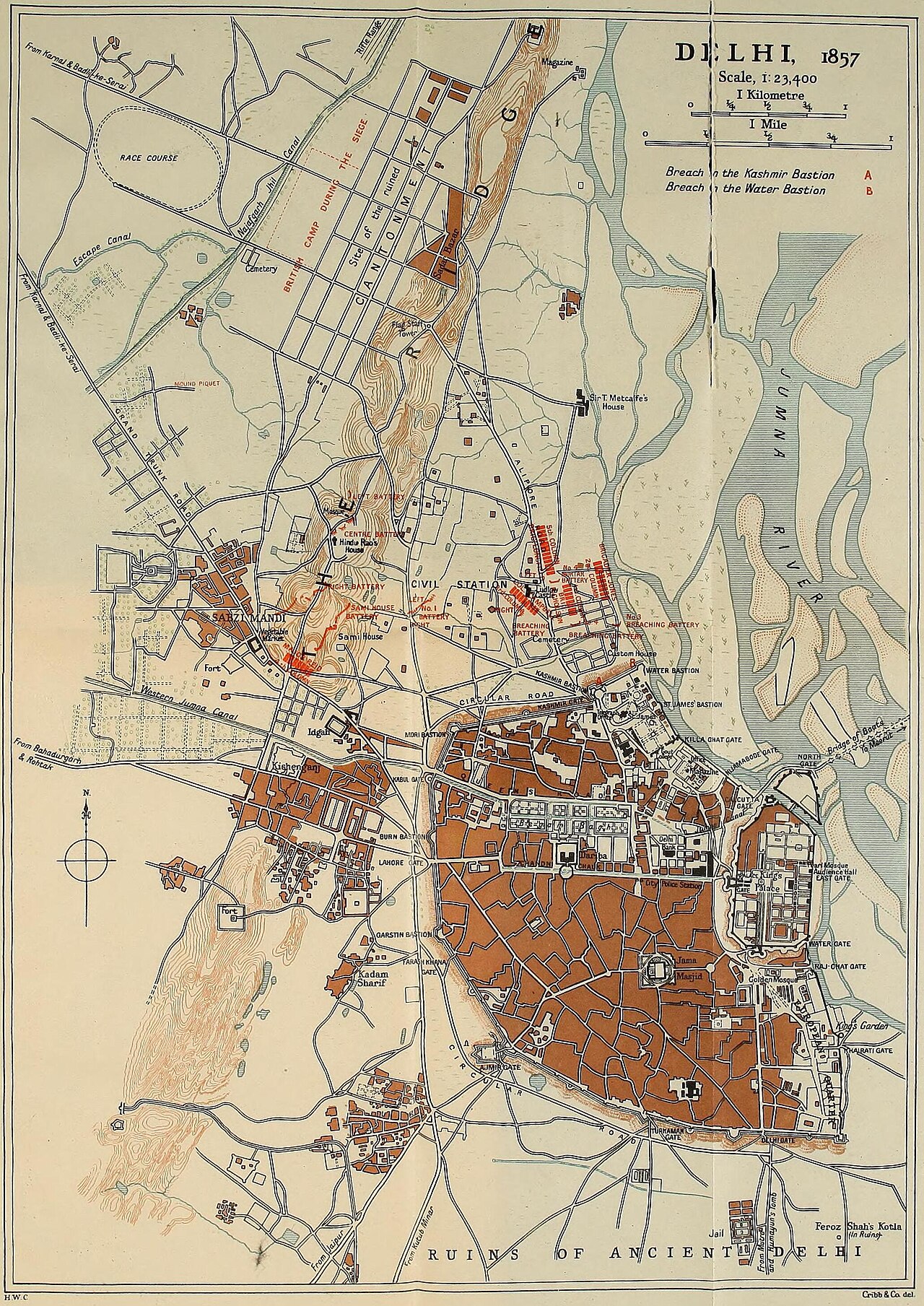
The events of 1857 are not really what people argue about. What they argue about is the name. And the fight over the name is one of the cleanest examples on this site of how a set of documented facts gets turned into a national story — by choosing a label.
Three names for one year
- The British called it the Sepoy Mutiny — a military insubordination to be put down, not a political event to be reckoned with.
- V. D. Savarkar, in 1909, gave it the name that stuck on the nationalist side: The Indian War of Independence of 1857. His opening chapter is titled “Swadharma and Swaraj” — religion and self-rule — and his thesis was that 1857 was a planned, national revolution, not a scattered mutiny. [Debated]
- The colonial-minimising name and the nationalist-maximising name are mirror images: each is a verdict wearing the costume of a title.
The official historian who wouldn’t say it
Here is the episode that makes the point unforgettable. In 1952 the Government of India set up a project to write the official history for the 1857 centenary, and appointed the eminent historian R. C. Majumdar to direct it.
[Documented] Majumdar concluded, from the evidence, that the revolt was neither “first,” nor “national,” nor a “war of independence” in any unified sense. His grounds were concrete: nationalism “in the true sense,” he argued, was absent in India until a much later date; the sepoys at Delhi refused to fight until their salaries were paid; and the Sikhs and Gurkhas fought for the British, not against them. Because that contradicted the framing the government wanted, he was removed from the project. He later published his findings independently as The Sepoy Mutiny and the Revolt of 1857 (1957), pointedly avoiding the word he had been asked to endorse.
The commission passed to Surendra Nath Sen, whose Eighteen Fifty-Seven (1957) became the official volume.
What the official volume actually said
Sen did not simply rubber-stamp the heroic version — and because his work is now public domain in India, we can quote him. He was blunt about the propaganda risk:
These authors wanted to represent the uprising as a planned war of independence organized by the nobility of India against the British Government. … not history but mere political propaganda.
And yet his own famous conclusion granted the label in part:
What began as a fight for religion ended as a war of independence, for there is not the slightest doubt that the rebels wanted to get rid of the alien government and restore the old order of which the King of Delhi was the rightful representative.
[Documented] He also noted the fact most slogans omit: “the army as a whole did not join the revolt” — a considerable section fought on the side of the Government.
The honest verdict
Hold the three accounts together and the truth is a spectrum, not a slogan. 1857 was more than a mutiny and less than a planned national war of independence. It began in the army over specific grievances (including religious ones — the greased cartridges); in places, above all Oudh, it swelled into something that looked like a war to expel the British and restore the old order; but it was regional, disunited, and much of India — and much of the army — sat it out or fought against it.
Which is exactly why the name is the battlefield. Call it “Mutiny” and you shrink it; call it “First War of Independence” and you unify what was never unified. This site’s rule applies to national heroes’ framings as strictly as to anyone else’s: keep the documented events in the foreground, and treat the triumphant label as the [Debated] interpretation it is. A historian was removed from his own government’s project for insisting on that distinction — which tells you how much the label was worth.