No subject on this site is more abused than the genetics of caste, and the abuse comes from every direction. So before any finding: the rule that governs the whole page.
The three-track rule
Genes, language, and caste are three separate tracks. Never collapse them into one arrow. A gene can travel without a language; a language can spread without genes; and neither is a caste, which is a social institution. We say migration, not the colonial invasion. A Y-chromosome haplogroup is not a caste and not a race. Hold those apart and the evidence is illuminating; merge them and you get propaganda, in whichever direction you prefer.
The consensus, stated plainly
The ancient-DNA record of the last decade has largely converged, and it is worth stating without hedging:
[Documented] Around 2000–1500 BCE, ancestry from Central Asian steppe pastoralists entered South Asia, correlating with the spread of Indo-Aryan languages and carrying, among male lineages, R1a-Z93 (Narasimhan et al., Science, 2019).
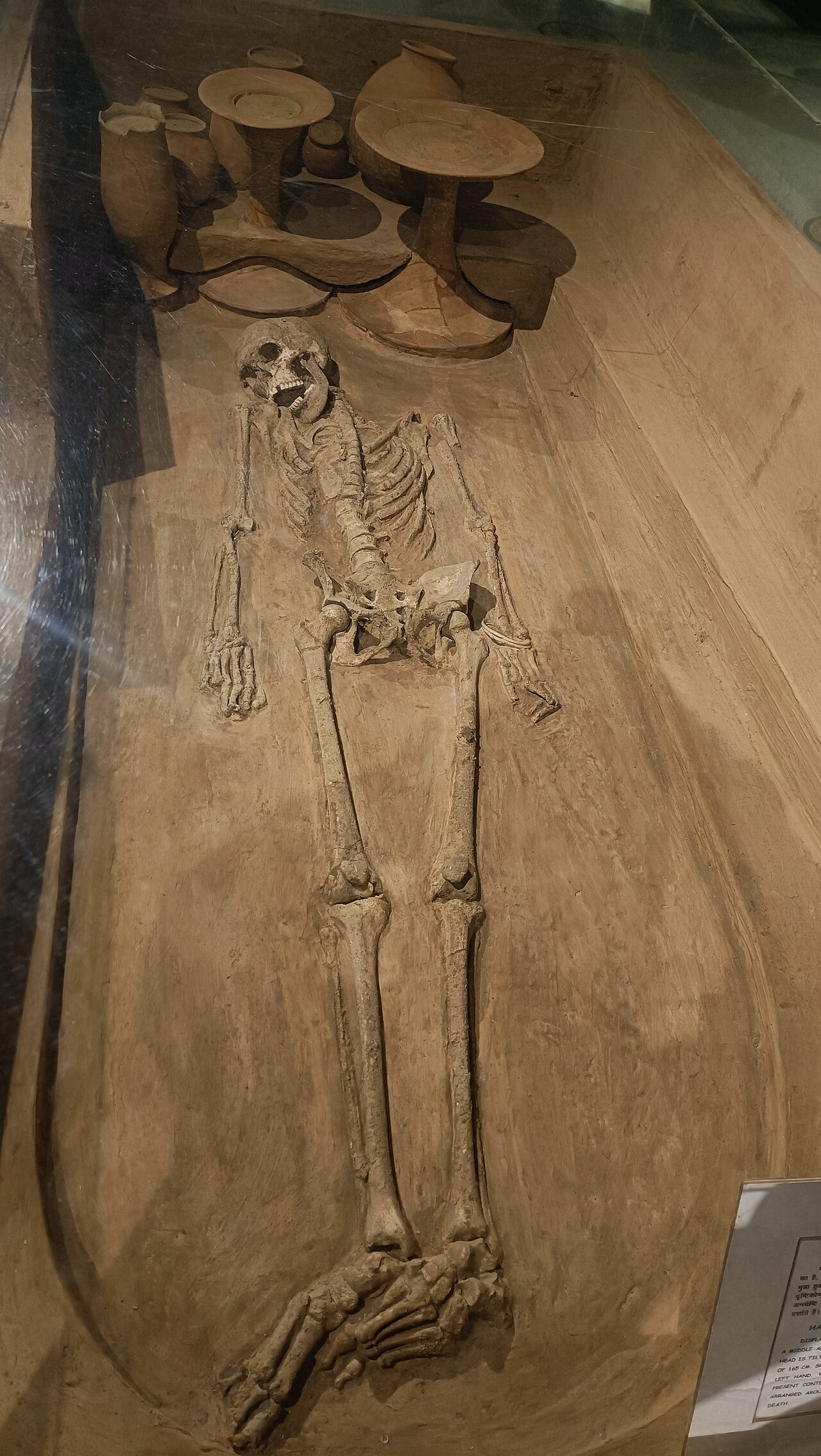
[Documented] The individual sequenced from the Indus Valley Civilisation site of Rakhigarhi (~2500 BCE) had zero steppe ancestry (Shinde et al., Cell, 2019). The great Harappan cities were built by people who were not steppe-derived — the IVC was not “Aryan.”
[Documented] In the Swat Valley, steppe ancestry appears in the samples only after ~1200 BCE — a gradual arrival, not a sudden conquest.
Modern South Asians are, in the standard model, a mixture of two ancestral populations — Ancestral North Indian (ANI) and Ancestral South Indian (ASI) — with steppe ancestry forming one component of ANI. And beneath both lies a far deeper substrate: the archaeological record shows continuous human presence in South Asia across tens of thousands of years. Steppe ancestry is a late, partial overlay on that ancient foundation — a recent layer, not the bedrock.
What the evidence does NOT license — correcting one side
Here is where a lazy anti-caste narrative overreaches, and this site does not get to wave it through because it is convenient.
“DNA proves the upper castes are foreign Aryan invaders.” [Debated] No. Three failures at once. First, invaders — it was migration and admixture over centuries, not a conquering army. Second, foreign as identity — everyone in South Asia is a mixture; steppe ancestry is a component, not an origin badge. Third, and most important, a haplogroup is not a caste and not a race. Carrying R1a does not make a person “Aryan” in any ethnic sense.
Be honest about the hard part: there is a documented statistical gradient — steppe ancestry runs somewhat higher, on average, in some northern and some upper-caste groups. Denying that is also a distortion. But a correlation is not an origin story: it is regionally variable, it is a matter of averages not individuals, and it does not mean caste was created by a race of invaders. The gradient is a fact; the invasion myth is a reading laid on top of it.
And the irony this site cannot omit: Ambedkar himself rejected the Aryan-race theory of caste. In Who Were the Shudras? (1946) he argued that the Vedas know no Aryan race, record no invasion, and that the distinction between Aryan and Dasa was not racial. An Ambedkar-centred site that imported a “foreign invader = upper caste” genetic story would contradict its own protagonist — and, as the companion essay notes, it is the exact point on which Ambedkar and Periyar split.
What the evidence does NOT license — correcting the other side
The discipline has to cut the other way too, or it is just partisanship.
“There was no migration; the Aryans were indigenous / Out of India.” [Debated] The Out-of-India position — that Indo-Aryan languages arose in South Asia and spread outward — is a minority view among specialists, and the ancient DNA runs against its strong form: steppe ancestry genuinely does arrive from outside, and Rakhigarhi genuinely lacks it. Wanting the answer to be “purely indigenous” does not make the samples cooperate.
And the “colonial-conspiracy” escape hatch is closed here: the Rakhigarhi study was Indian-led — the sampling and analysis ran through CCMB Hyderabad and the Birbal Sahni Institute, published with international collaborators in 2019, decades after the British left. Whatever one thinks of the old colonial “Aryan invasion” framing, this evidence was not manufactured in London. It is Indian scientists reading Indian bones. “The British made it up” cannot reach a genome sequenced in Hyderabad.
The one finding both sides skip: endogamy
Ancient and modern DNA also shows something neither camp likes to dwell on: caste endogamy is deep and old. Many Indian jatis have married within themselves for a very long time, leaving them genetically distinguishable — strong population structure produced by marriage rules, not by separate origins (Reich and colleagues). [Documented]
Read it carefully, because it is easy to abuse. It says nothing about superiority, purity, or foreign-ness. It is simply the genetic shadow of the jati endogamy the Dharmaśāstra prescribed — the biological fingerprint of a social rule. Caste did not come from the genes; the genes carry the mark of caste.
Why we hold it this way
The science is settled enough to state — a real steppe migration, a non-steppe Indus Valley, deep endogamy — and abused enough that the only responsible way to carry it is on three separate tracks, with the corrections pointed everywhere at once. Genes are not destiny, a haplogroup is not a caste, and the man this site is built around said so himself, seventy years before the DNA came in to agree with him.