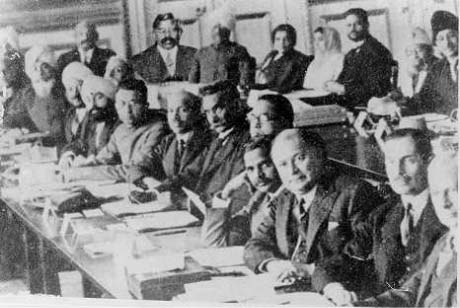
Three times between 1930 and 1932, the British convened the Indian political classes in London to negotiate the country’s constitutional future. The Round Table Conferences did not produce agreement — but they staged the two arguments that still shape how India remembers this period, and both are worth getting right, because both are usually flattened.
The setting
The First Conference (1930–31) met without the Congress, which was in the middle of the Civil Disobedience movement and whose leaders, Gandhi included, were in jail. B. R. Ambedkar attended, and used the platform to put the Depressed Classes on the imperial record as a distinct people needing their own political safeguards. The Second Conference (1931) is the one that matters most: Gandhi came as the sole representative of the Congress, and the collisions happened there.
Collision one: Gandhi and Ambedkar — a fight between allies
The caricature is “Gandhi against Dalit rights.” The record is more precise, and more interesting.
Ambedkar demanded separate electorates for the Depressed Classes — constituencies where only Dalits would vote for Dalit candidates — arguing that without them, untouchable representatives would owe their seats to the caste-Hindu majority and never truly answer to their own people. He pressed the case alongside other minorities in a joint “Minorities Pact.”
Gandhi opposed separate electorates — but, crucially, not representation itself. [Documented] He was willing to guarantee the untouchables reserved seats, even generously; what he would not accept was a separate electorate, which he believed would wall the untouchables off from Hindu society permanently — “the perpetual bar sinister,” as he put it. He framed his refusal in the strongest terms: “I would not sell the vital interests of the Untouchables even for the sake of winning the freedom of India.”
So the two men wanted the same end — the uplift and representation of the untouchables — and split over the mechanism. [Debated] Whether a separate electorate would have empowered Dalits (Ambedkar) or ghettoised them (Gandhi) is exactly the kind of question this site leaves to you. What is not in dispute is the sequel: the British granted separate electorates in the Communal Award (1932), Gandhi fasted against it, and the Poona Pact replaced them with reserved seats — the story told in its own essay.
Collision two: Gandhi and Churchill — a fight between adversaries
The second collision was not over how to help the untouchables but over whether Indians should govern themselves at all — and here Gandhi’s opponent was not in the room. Winston Churchill, out of office, led the Conservative “die-hard” faction against the Round Table process and against any concession to Indian self-rule, founding the India Defence League to fight the reforms.
His contempt was personal and public. On 23 February 1931, opposing Gandhi’s very participation, Churchill said:
It is alarming and also nauseating to see Mr Gandhi, a seditious Middle Temple lawyer, now posing as a fakir… striding half-naked up the steps of the Viceregal palace… to parley on equal terms with the representative of the King-Emperor.
[Documented] The line is authentic — and it carries a bonus lesson for a site about distortion. The Associated Press garbled it, reporting “middling lawyer” for “Middle Temple lawyer” — two quite different insults — and Churchill, when the remark was later quoted back to him, reportedly replied that it was “a misquotation” and that what he really said “was rather more severe.” Even the era’s most famous quote about India was mistransmitted; check the wording, always.
Why the distinction matters
Hold the two collisions apart and the period comes into focus. Gandhi vs Ambedkar was an argument inside the freedom movement, between two men committed to ending untouchability, over the means — bitter precisely because the stakes were shared. Gandhi vs Churchill was an argument across the colonial divide, between a man seeking self-rule and a man determined to deny it. Collapsing them — treating Gandhi’s fight with Ambedkar as if it were the same kind of thing as his fight with the Empire — is a category error.
The conferences themselves failed to reach a settlement, but they fed directly into the Government of India Act, 1935, the last colonial constitution and the structural ancestor of the document Ambedkar would draft fifteen years later. The men who argued in London in 1931 were rehearsing, without knowing it, the questions the Constituent Assembly would finally answer.